

EMDR THERAPY IN RALEIGH, NORTH CAROLINA
Create space from the past to embrace the present
Go beyond traditional talk therapy. Get genuine care from a trauma-informed, EMDR trained therapist and EMDRIA member in Raleigh who supports adults across North Carolina, including Charlotte, Greensboro, and Winston-Salem.
Find relief from pain and hope for healing

ADDRESS DIFFICULT MEMORIES
Heal the Past to Change the Present
Eye Movement Desensitization and Reprocessing (EMDR) therapy distinguishes itself from other modalities by allowing your mind and body to work through past highly stressful events and carry them in an adaptive way.
This non-pathologizing approach understands the distress experienced by each individual reflects no fault or limitation of the person. Rather, this therapy recognizes the distress as the outcome of unprocessed memories and adaptive survival mechanisms that no longer serve the person.
Different Than Talk Therapy
Use of existing information and logic to resolve unprocessed memories through talk therapy can only get you so far.
With this treatment method, you take a bottom-up approach that focuses on the physiological storage of memory. This method also brings attention to your nervous system and recognizes that the body has a natural capacity to heal itself.
Individuals with post-traumatic stress disorder (PTSD), complex PTSD, stress-related issues, or unwanted trauma symptoms can benefit from this method. Learn more about how EMDR works within trauma therapy.
Grounding First
To manage psychological distress, the first step of EMDR therapy equips you with regulation and coping strategies, otherwise known as grounding techniques and self-soothing practices.
Activities in the first phase can include mindful breathing exercises, orienting skills, a personalized list of sensory items, and EMDR-specific techniques, such as the butterfly hug and creation of a calm place.

OVERVIEW OF THE COMPREHENSIVE TREATMENT PROCESS
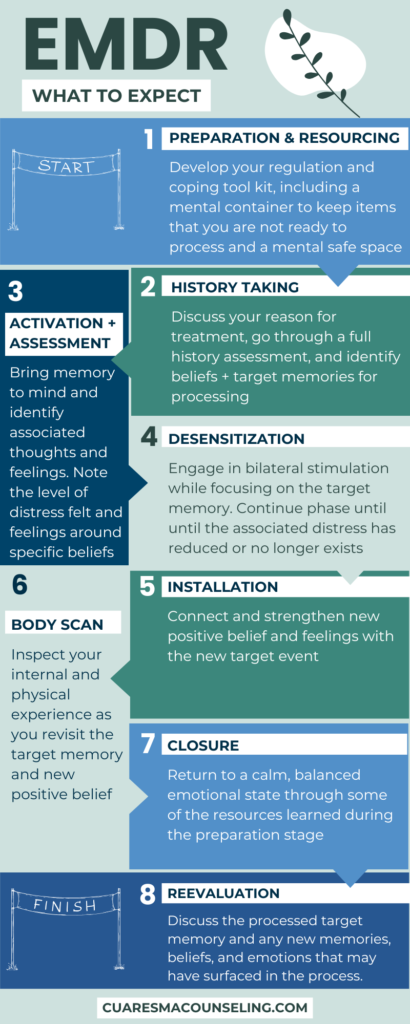
Discover All Eight Phases
While you may be interested in reprocessing only, this memory-based approach requires all eight stages to harness its full potential and integrate new learning and insight.
Check out the infographic below for specific around each phase.

OPTIONS FOR BILATERAL STIMULATION
Select Your Preferred Format
When Francine Shapiro developed EMDR in 1987, bilateral stimulation (BLS) was originally achieved using eye movement. This required a person to track their therapist's fingers move from left to right.
Today, BLS can be achieved a variety of ways and across other senses. Also, you have the ability to change your desired format at any time.
Visual BLS
Follow a large dot move across your screen as it moves from left to right multiple times (see image). Color options of the dot include red, green, blue, and yellow.
Aural BLS
Listen to neutral, pleasant sounds, using headphones or ear buds as the sound alternates between your left and right ear for an amount of time, roughly 15 to 30 seconds for each set. Sound options include a bass guitar, heart beat, and finger snap.
Tactile BLS
Cross your arms and tap your shoulders or the top of your thighs multiple times. An alternative to tapping is marching in place while you are seated.


ASSESSMENT OF FIT WITH THIS APPROACH
Make sure you and EMDR are a match
Client EMDR Selection Criteria
Generally, the majority of adults are a good candidate for EMDR therapy. Just like a medical doctor ensures their patient can receive a specific medical procedure, your therapist will make sure that you are a good fit for this memory-based approach.
The client EMDR criteria checklist encompasses items pertaining to your physical state, any current legal matters, and psychological wellbeing.
Dissociative Experiences Scale - II
All individuals dissociate at some point during their daily lives. For instance, some people may not pay attention while listening to an individual speak, mentally drifting off and thinking about their plans for the evening. This is all typical and normal.
In EMDR therapy, clients need to have one foot in the present and one foot in the past. By using the Dissociative Experiences Scale (DES-II), your therapist can determine the extent to which you might dissociate and whether EMDR may need to be adjusted to you.


IN PERSON THERAPY IN DOWNTOWN RALEIGH
Get Treatment at Current Wellness
Your therapist adapts EMDR to meet your personal needs. The process or efficacy remains the same whether you meet your therapist in-person at Current Wellness or online via telehealth video.
Join your therapist in an inviting, thoughtfully-designed therapy room that has adjustable lighting, sensory tools (e.g., weighted blanket, fidget spinner), and comfortable sofa and chairs.

ONLINE THERAPY VIA TELEHEALTH VIDEO
Receive Support from Any Location in North Carolina

Engage in EMDR from the comfort and privacy of your own space. Prioritize your mental health and save time without the inconvenience of a commute.
Access your video session through a secure link in your client portal.
FREE DIGITAL EMDR THERAPY WORKBOOK
Follow the Process with Info Specific to Each Phase

EMDR clients get a FREE digital workbook to use during the course of therapy and keep afterwards. This was made only for Cuaresma Counseling clients.
The workbook contains written descriptions, links to videos, and images for each EMDR resource developed. Additionally, the workbook features useful tools for each step of EMDR, such as a fillable TICES log.

BENEFITS OF BEST FEATURE
Use a Framework That Adjusts to You
The most important feature of EMDR therapy is the adaptable framework. EMDR accommodates your present concerns and needs. Whether addressing maladaptive beliefs about self (e.g., I am unloveable, I am not enough) or stress-related symptoms, EMDR therapy can do just that.
Do you need to process a single event that features multiple emotionally-charged scenes? We can segment the memory into smaller events, no problem.
Are you carrying multiple negative self-beliefs about yourself linked to varied events? Sure, let's create a plan around each one for processing.
Is dealing with frequent triggers getting in the way of your daily functioning? No problem, let's identify them and get to work.

TREATMENT OF PHOBIA
Process the Events and Memories Contributing to Your Fear

EMDR therapy addresses simple phobias (i.e., fear of an object) and process phobias (i.e., fear of a situation where you need to participate actively).
Together, we will identify the specific memories and events that have contributed to your fear.
Remove Fear from Phobias
EMDR therapy helps you resolve and integrate these memories so they lose their emotional charge. Once these memories become neutral, they will no longer stand in your way. In other words, these specific events and memories that seem still active no longer stop you from participating in situations where fear stopped you.
Identify Target Memories
The procedure for EMDR therapy for phobias features a three-prong approach:
- Past- memories that include the first time experiencing the fear, most disturbing experience, and most recent
- Present- triggers of any associated stimuli and physical sensations that elicit your fear response
- Future- encompasses fear-free future action and a contract for action

COLLABORATION WITH A SKILLED EMDR THERAPIST
Work with a Therapist with Proven EMDR Therapy Experience
Process difficult memories and let go of associated negative self-beliefs with a trauma-informed counselor.
EMDR Therapy Experience
- Provided virtual and in-person EMDR therapy in Raleigh and across North Carolina with neurodiverse clients of various cultural backgrounds starting in 2023
- Completed basic training in EMDR with Thrive Training
- Supervised by Kelly Caniglia, a clinician trained in EMDR who specializes in trauma and Complex PTSD
Advanced EMDR Therapy Skills
- Foundations of Somatic-Focused EMDR Therapy
- EMDR & Somatic Therapy
- Neurodivergent Informed EMDR: Autism and ADHD
- EMDR for Recent Events and Early Interventions
- Advanced EMDR Skills
Real Client Results
- Reduced self-reported trauma symptoms as measured by PCL-5 (PTSD Checklist for DSM-5) by over 70%
- Reinforced positive belief that client is safe following a car accident in the past month
- Addressed stuck childhood memories through reprocessing
- Increased duration of sleep after processing sequence of traumatic event

LEARN MORE
Dig into the Full Process and Efficacy
Access the resources below for more information about this effective therapeutic approach.
Research, Benefits, and More
EMDRIA does a wonderful job of providing details about the approach and listing important information around the effective form of therapy for trauma. Visit https://www.emdria.org/about-emdr-therapy/ to learn more.
EMDRIA Video Overview
EMDR International Association (EMDRIA) provides information about how EMDR therapy works, what it is like, and how widely it is recognized.
Video Demonstration and Explanation
Watch the video demonstration to see EMDR therapy in action and get a sense of the process as it would unfold in Raleigh or your space in North Carolina.
APPLICATION OF EMDR THERAPY
Support Individuals with Varying Concerns

This type of treatment assists adults who experience concerns related to the following (and much more):
- Anxiety and panic attacks
- Grief and loss
- Performance anxiety
- Post-Traumatic Stress Disorder (PTSD) and other trauma and stress-related issues
- Sexual assault
- Violence and abuse
Ready to work through your unprocessed memories?
Schedule a free, 15-minute video consultation with Janice, a trauma-informed and EMDR trained therapist in Raleigh who serves all of North Carolina.